Showing posts with label sports history. Show all posts

History of Golf & Golf Equipment

Golf originated during the 15th century.

Golf originated from a game played on the coast of Scotland during the 15th century. Golfers would hit a pebble instead of a ball around the sand dunes using a stick or club. After 1750, golf evolved into the sport as we recognize it today. In 1774, Edinburgh golfers wrote the first standardized rules for the game of golf.

Golf Balls
Golfers soon tired of hitting pebbles and tried other things. The earliest man-made golf balls included thin leather bags stuffed with feathers (they did not fly very far).

The gutta-percha ball was invented in 1848 by Reverend Adam Paterson. Made from the sap of the Gutta tree, this ball could be hit a maximum distance of 225 yards and was very similar to its modern counterpart.

In 1898, Coburn Haskell introduced the first one-piece rubber cored, when professionally hit these balls reached distances approaching 430 yards.

According to "The Dimpled Golf Ball" by Vincent Mallette during the early days of golf the balls were smooth. Players noticed that as balls became old and scarred, they traveled farther. After a while players would take new balls and intentionally pit them.

In 1905, golf ball manufacturer William Taylor was the first to add the dimple pattern using the Coburn Haskell ball. Golf balls had now taken on their modern form.

Golf Clubs
Golf clubs have evolved from wooden shaft clubs to today's sets of woods and irons with durability, weight distribution and graduation utility. The evolution of clubs went hand in hand with the evolution of golf balls that were able to withstand harder whacks.

Carrying & Caddies
During the 1880s, golf bags first came into use. "The beast of burden" is an old nickname for the caddie who carried golfers' equipment for them. The first powered golf car appeared around 1962 and was invented by Merlin L. Halvorson.

Golf Tees
The word "tee" as it relates to the game of golf originated as the name for the area where a golfer played. In 1889, the first documented portable golf tee was patented by Scottish golfers William Bloxsom and Arthur Douglas. This golf tee was made from rubber and had three vertical rubber prongs that held the ball in place. However, it lay on the ground and did not piece (or pegged) the ground like modern golf tees.

In 1892, a British patent was granted to Percy Ellis for his "Perfectum" tee that did piece (pegged) the ground. It was a rubber tee with a metal spike. The 1897 "Victor" tee was similar and included a cup-shaped top to better hold the golf ball. The Vicktor was patented by Scotsmen PM Matthews.

American patents for golf tees include: the first American patent issued to Scotsmen David Dalziel in 1895, the 1895 patent issued to American Prosper Senat, and the 1899 patent for an improved golf tee issued to George Grant.

In 1774, the first standardized rules of golf were written and used for the first golf championship, which was won by Doctor John Rattray on 2nd April 1744 in Edinburgh, Scotland.

1. You must tee your ball within one club's length of the hole.

2. Your tee must be on the ground.

3. You are not to change the ball which you strike off the tee.

4. You are not to remove stones, bones or any break club for the sake of playing your ball, except on the fair green, and that only within a club's length of your ball.

5. If your ball comes among water, or any watery filth, you are at liberty to take out your ball and bringing it behind the hazard and teeing it, you may play it with any club and allow your adversary a stroke for so getting out your ball.

6. If your balls be found anywhere touching one another you are to lift the first ball till you play the last.

7. At holeing you are to play your ball honestly for the hole, and not to play upon your adversary's ball, not lying in your way to the hole.

8. If you should lose your ball, by its being taken up, or any other way, you are to go back to the spot where you struck last and drop another ball and allow your adversary a stroke for the misfortune.

9. No man at holeing his ball is to be allowed to mark his way to the hold with his club or anything else.

10. If a ball be stopp'd by any person, horse or dog, or anything else, the ball so stopp'd must be played where it lyes.

11. If you draw your club in order to strike and proceed so far in the stroke as to be bringing down your club; if then your club shall break in any way, it is to be accounted a stroke.

12. He who whose ball lyes farthest from the hole is obliged to play first.

13. Neither trench, ditch or dyke made for the preservation of the links, nor the Scholar's Holes or the soldier's lines shall be accounted a hazard but the ball is to be taken out, teed and play'd with any iron club. Read More......

The History of Softball


Softball originated in Chicago on Thanksgiving Day, 1887. A group of about twenty young men had gathered in the gymnasium of the Farragut Boat Club in order to hear the outcome of the Harvard-Yale football game. After Yale's victory was announced and bets were paid off, a man picked up a stray boxing glove and threw it at someone, who hit it with a pole. George Hancock, usually considered the inventor of softball, shouted, "Let's play ball!" He tied the boxing glove so that it resembled a ball, chalked out a diamond on the floor (smaller dimensions than those of a baseball field in order to fit the gym) and broke off a broom handle to serve as a bat. What proceeded was an odd, smaller version of baseball. That game is now, 111 years later, known as the first softball game. Softball may have seen its death on the day of its birth if Hancock had not been so fascinated by it. In one week, he created an oversized ball and an undersized rubber-tipped bat and went back to the gym to paint permanent white foul lines on the floor. After he wrote new rules and named the sport indoor baseball, a more organized, yet still new, game was played. Its popularity was immediate.

Hancock's original game of indoor baseball quickly caught on in popularity, becoming international with the formation of a league in Toronto. That year, 1897, was also the premiere publication of the Indoor Baseball Guide. This was the first nationally distributed publication on the new game and it lasted a decade. In the spring of 1888, Hancock's game moved outdoors. It was played on a small diamond and called indoor-outdoor. Due to the sport's mass appeal, Hancock published his first set of indoor-outdoor rules in 1889.

While Chicago was definitely softball's birthplace, the game saw some modification in Minneapolis. The year was 1895 when Lewis Rober, Sr., (a fire department officer) needed an activity to keep his men occupied and in shape during their free time. He created his game to fit the confines of a vacant lot next to the firehouse and the result was instantly appealing. Surprisingly, Rober was probably not familiar with Hancock's version of the sport because it was still concentrated in Chicago at that time. The following year, 1896, Rober was moved to a new unit with a new team to manage. In honor of this group's name, the Kittens, the game was termed Kitten League Ball in 1900. The name was later shortened to kitten ball.

In order to reach the Olympics, the women's sport of softball obviously had to grow greatly from its beginnings. The first women's softball team was formed in 1895 at Chicago's West Division High School. They did not obtain a coach for competitive play until 1899 and it was difficult to create interest among fans. However, only five years later, more attention was given to the women's game. The Spalding Indoor Baseball Guide 1904 issue fueled this attention by devoting a large section of the guide to the game of women's softball.

The Chicago National Tournament in 1933 also advanced the sport. At this competition, the male and female champions were honored equally. The International Softball World Championships in 1965 developed women's softball by making it an international game, a step towards the Pan-American Games and the Olympics. Eleven years later, women softball players were given the closest equivalent to Major League Baseball with the 1976 formation of the International Women's Professional Softball League. Player contracts ranged from $1,000 to $3,000 per year, but the leage disbanded in 1980 because of financial ruin. Vicki Schneider, a St. Louis Softball Hall of Famer and former professional player, recalls this league as being the high point of her career (Schneider).

The popularity of women's fastpitch softball has grown steadily since the professional league's end in 1980. In fact, once again, there is another professional fastpitch league. The Amateur Softball Association reports that it "annually registers over 260,000 teams combining to form a membership of more than 4.5 million" (About the ASA). These numbers do not all apply to fastpitch, yet it is consistently growing along with slowpitch. Vicki Schneider has seen a major growth in popularity and intensity for the sport since she has been involved. She says it is also very obvious that girls are consistently getting more involved and more competitive at an earlier age. Increased media coverage and the Olympics have greatly contributed to this development (Schneider). There is obviously some special appeal of fastpitch softball that has allowed it to steadily grow in popularity through the years. Through the technology of the internet, those who are currently involved in the sport were asked for their personal opinions on the mass appeal of women's fastpitch softball.

First of all, why are these millions of people involved in softball, not baseball? Is it just a substitute for baseball or is there a difference? John Kralik replies, "...[Baseball] can't adapt to the age groups without corrupting the game. Softball can and does" (Kralik). Megan Flaherty, 18, says that unlike baseball, softball is "not all about raw strength. You must think about what to do and when to do it. Out-of-the-park homeruns won't occur too often so you have to rely on other methods of getting around the bases quickly" (Flaherty). Londa Kauffman feels that softball is much faster and more exciting than baseball (Kauffman). More specifically, Dave Davis, an ASA umpire, says, "I grew up loving baseball in an era before sports became a big business. Labor strife and big egos have gone a long way to taint my view of the Major Leagues. I have found that sports are played more intensely on the amateur level. I also believe that in most cases, the fastpitch softball games are more exciting to watch than baseball. The rules are similar, to be sure, but the smaller dimensions seem to add to the action" (Davis).

Once a person chooses to become involved in fastpitch softball, the sport must have some priority to him or her. Does fastpitch play an important role in a person's life? Dot Richardson put aside her medical career in order to fulfill her Olympic dream. Therefore, softball must be a high priority to her. Robin Scott obviously agrees with Richardson, to a more extreme degree. She says, "NOTHING comes before softball. I don't care what it is. My first priority is softball, then everything else comes next" (Scott). Dave Davis, 35, has the same attitude. On his first anniversary, his wife insisted that he miss a softball game in order to take her out to dinner. Looking back, he replies, "Some nerve!" (Davis).

Others put softball high on their list of priorities, but it is not first. Many players agree that school must come before their sport. Skelly Skadsen, 17, feels that "school will take you somewhere in life and softball is good for memories" (Skadsen). Kelly Dwyer, a former Division I player, always put family and school before softball because "as much as [she] loved it, [she] knew that after college there wasn't a pro league" (Dwyer). Vicki Scheider, now the owner of The Batting Cage in Valley Park, Missouri, puts God and family at the top of her priority list and they have been in that position all of her life, no matter what she achieved in fastpitch softball (Schneider).

Why is softball so often a top priority? What aspect of softball makes it so appealing? Everyone who plays, coaches, umpires, or watches women's fastpitch softball has something in common. They all like and enjoy the game. However why do they, similar to generations before them, enjoy fastpitch softball?

Erin Anderson, a fourteen-year-old player in Tennessee, says, "The girls are great... I've met so many people and had such a good time these past couple of years. You can really find some good friends... Road trips, hotels, playing all kinds of different teams are all a part of why I love this game" (Anderson). Kelly Stellfox loves "the friendships you make [in fastpitch]" (Stellfox) and another player, 16, says that there is a "sorority among her teammates" (Anonymous). Katherine Hyrcyna supports this personal aspect, pointing out that there are no superstars in fastpitch. She says, "Softball is all about trust and family. [For example,] the shortstop made a great diving catch, but the first baseman caught her throw, or the pitcher threw a no-hitter, but [the right fielder] caught that line drive and saved the no-hitter" (Hyrcyna).

Many others enjoy the physical activity that surrounds fastpitch. Michelle Eastman, 16, loves "... the rush of winning, sliding, making a diving catch, hitting an awesome triple... [and] the pure adrenaline that comes with playing hard and succeeding" (Eastman). A player in Dallas, Texas, loves "... that action of fielding a ball and throwing it... diving for balls and making the catch... running bases, leading off, stealing, and sliding... the competition... the athleticism... the fast-paced nature of the game... the team work... [and] how everything comes together and fits together like puzzle pieces, everyone doing their job" (Anonymous). Laurel Munski, from New York, is fascinated with the "unknown" aspect of fastpitch. She states, "You can't really predict what the batter might do when up at the plate; you can only react. The same is true when you [are batting]. You don't know what the pitcher is going to pitch to you; you can only react to where it is and decide [whether or not] to swing" (Munski). Similarly, Cyrena Gawuga plays because she "[likes] the challenge" (Gawuga). Others, like Vicki Schneider, enjoy the fact that softball is a team sport, but a player can set individual goals for herself (Schneider).

Coaches also have important points of view on why they are involved in women's fastpitch softball. Bob Prastine remarks, "When you see in [your players'] eyes that something you have been trying to get them to understand for weeks finally clicks and they use and understand that knowledge in a real game situation, well, it makes all your effort worthwhile" (Prastine). Lynn Ditlow, from Pennsylvania, says of coaching, "If I can coach others with good skills, theory, and mechanic, help them develop their knowledge and skills, and have fun with this sport, then I've been able to contribute to another's success." She adds, "My reward is knowing [that] I've helped [players] to reach their goals" (Ditlow). Bill Lammel supports this viewpoint. "I love and care for all the girls that play for me and want them to excel. Softball is a good way to teach them values, self-esteem, and how to work together for a common goal. [These are] skills that they can use throughout their lives" (Lammel), he says. Paul O'Brien in Maryland enjoys coaching young women because they "are much more appreciative of a coach's work than boys and there are less superstar/know-it-all attitudes" (O'Brien).

From an umpire's point of view, Rich Rosa, 44, believes that he has "the best seat in the house" (Rosa). Another ASA umpire, Dave Davis, says that his job is rewarding: "Knowing that I'm giving something back to the game from which I have received so many great memories is great." He also adds, "I want people to be happy to see that it's me working their game. I pride myself in my preparation and my main goal is to become the most consistent official that I can" (Davis).

Sharon Whaley, the mother of a college softball player, also has a special feeling about the sport. "I love seeing my daughter excel at something she loves so much... It's really hard to explain the feeling you get as a parent when your child is so happy with her accomplishments" (Whaley). Whaley is not the only one with unexplainable feelings concerning softball, feelings well described by Kelly Dwyer. She says that softball's appeal is "... just a feeling you get when you play, just an overall feeling of elation and joy when you are playing. It's kind of like asking someone why they love their boyfriend. It's hard to name one thing; it's just that you feel comfortable and happy when you are with them. [It is the] same thing with softball" (Dwyer). Dot Richardson agrees. When she plays there is a "passion from within" that is impossible to explain. It is that passion that makes her love the game, not the championships, gold medals, endorsements, autographs, or other publicity (Richardson).

This unexplainable love and passion for softball has allowed the sport to grow, develop, and maintain universal appeal throughout time. For the past 111 years, softball, "a game for everyone," has united people with a mysterious feeling. George Hancock had this feeling in 1887 and Dot Richardson, along with millions of others, has it today. The feelings that surround softball and its players are timeless.
Read More......

Swimming History


The English are considered the first modern society to develop swimming as a sport. By 1837 swimming competitions were being held in London's six artificial pools, these competitions were organized by the National Swimming Society in England. As the sport grew in popularity many more swimming pools were built, and when a new governing body, the Amateur Swimming Association of Great Britain, was organized in 1880, it numbered more than 300 member clubs.


In 1896, swimming became an Olympic sport for men with the 100 meters and 1500 meters freestyle competitions held in open water. Soon after, as swimming gained popularity, more freestyle events were included, followed by the backstroke, butterfly, breaststroke, and lastly, the individual medley.

For a variety of reasons, women were excluded from swimming in the first several Olympic Games. In 1896 and again in 1906, women could not participate because the developer of the modern games, Baron Pierre de Coubertin, held firmly to the assumption, common in the Victorian era, that women were too frail to engage in competitive sports. It was only at the 1912 Games when women's swimming made its debut at the prompting of the group that later became known as the International Olympic Committee.

The first modern Olympic Games had only four swimming events, three of them freestyle. The second Olympics in Paris in 1900 included three unusual swimming events. One used an obstacle course; another was a test of underwater swimming endurance; the third was a 4,000-metre event, the longest competitive swimming event ever. None of the three was ever used in the Olympics again.

From this humble beginning with four swimming events, the Olympics have now developed to 32 swimming races, 16 for men and 16 for women. The Special Olympics includes competitive swimming for people with disabilities and has 22 events for men and 22 for women.
Read More......

History of chess


Chess is more than a game of skill-it is a medieval history lesson in miniature.


Have you ever played chess? Did you know that chess is the oldest skill game in the world? But chess is more than just a game of skill. It can tell you much about the way people lived in medieval times. If you look at the way a chess board is set up, then study the pieces and how they are used, you will realize that chess is a history of medieval times in miniature. The six different chess pieces on the board represent a cross section of medieval life with its many ceremonies, grandeur, and wars.


Chess was played many centuries ago in China, India, and Persia. No one really knows for sure in which country it originated. Then, in the eighth century, armies of Arabs known as Moors invaded Persia. The Moors learned chess from the Persians. When the Moors later invaded Spain, the soldiers brought the game of chess with them. Soon the Spanish were playing chess, too. From Spain, chess quickly spread throughout all of Europe.

Europeans gave chess pieces the names we know today; they probably had trouble pronouncing and spelling the Persian names, so they modernized them to reflect the way they lived. Today, the names certainly aren’t modern but a thousand years ago they represented the very way in which both ordinary people and persons of rank lived their lives.


The pawns on the chess board represent serfs, or laborers. There are more of them than any other piece on the board, and often they are sacrificed to save the more valuable pieces. In medieval times, serfs were considered no more than property of landowners, or chattel. Life was brutally hard for serfs during this era of history. They worked hard and died young. They were often left unprotected while wars raged around them. They could be traded, used as a diversion, or even sacrificed to allow the landowners to escape harm.


The castle piece on a chess board is the home, or the refuge, just as it was a home in medieval times. In chess, each side has two castles, or rooks, as they are sometimes called.

The knight on a chess board represents the professional soldier of medieval times whose job it was to protect persons of rank, and there are two of them per each side in a game of chess. Knights in a game of chess are more important than pawns, but less important than bishops, kings, or queens. Their purpose in the game of chess is to protect the more important pieces, and they can be sacrificed to save those pieces just as pawns can.


There is a bishop in the game of chess, who represents the church. The church was a rich and mighty force in medieval times, and religion played a large part in every person’s life. It is no wonder that a figure that represented the concept of religion found its way into the game. A bishop was the name for a priest in the Catholic church who had risen through the ranks to a more powerful position. In the game of chess, there are two bishops for each side.


The queen is the only piece on the board during a chess game that represents a woman, and she is the most powerful piece of the game. In the game of chess, there is only one queen for each side. Many people do not realize that queens in medieval times often held a powerful, yet precarious, position. The king was often guided by her advice, and in many cases the queen played games of intrigue at court. But kings could set wives aside or even imprison them in nunneries with the approval of the church (and without the queen’s approval), and many women schemed merely to hold her place at court. The machinations of queens working either for or against their kings are well noted in history throughout medieval times, and often she held more power than the king did.


The king is the tallest piece on the board, and is as well defended on the chessboard as in medieval life. In medieval times, the surrender of the king would mean the loss of the kingdom to invading armies and that could mean change for the worse. It was to everyone’s advantage, from the lowest serf to the highest-ranking official, to keep the king safe from harm. The king is the most important, but not the most powerful piece in chess. If you do not protect your king, you lose the game.

The next time you set up your chessboard and get ready to play a friendly game or two, think of chess as a history lesson. The pieces on the board represent a way of life that is no more, and the real life dramas that occurred in medieval times are now only a game.
Read More......

History of NASCAR


The starting point.

At the end of the World War II, the request for new cars in the USA made a considerable jump with the return of the soldiers. The industry which had produced weaponry for 5 years applied at once their designs to the new cars. The result was the arrival on the market of fast, powerful and robust cars which were enjoyed by the young people of the time. Those started to organize more or less legal races, and soon trends started to form.

The American West was impassioned for the "sports" cars, the Midwest for those with uncovered wheels, whereas South-east chose the stock cars. A lot of these were modified to carry out the illegal alcohol traffic and used in the "races".

This passion for auto racing did not escape the promoters who quickly made an "official" sport out of it, creating many organizations, each with their own rules. Some of them were the NCSCC (National Championship Stock Car Circuit), NSCRA (National Stock Car Racing Association), etc....

Unfortunately, this prevented auto racing from reaching the national level. Moreover, no guarantee of payment was offered to the pilots: if there was money remaining in the pot after the race, so much better, if not...

The birth.

On December 14, 1947, Bill France, who was himself part of the NSCRA, decided to meet with thirty five of the leaders of all associations in place to draw the lines of what was going to become the American national automobile sport.

It took four days for the group to staighten all the rules, to choose the name of NASCAR (National Association for Stock Car Auto Racing) and the Association was finally officially created on February 21, 1948.

The first races.

They were run the same year with modified pre-war cars, which later became the "modified" series. The championship comprised 52 races, and the first winner was Red Byron, who pocketed $1250.

As soon as 1949, Bill France put his very first idea into practice: a "strictly stock" series - no modification accepted. This brought a controversy which one can describe as historical at the end of the first race at Charlotte. Glenn Dunnaway won the race with his 1947 Ford, but was declared illegal because of a modification of the rear springs (Dunnaway used his car to carry moonshine). Jim Roper pocketed the $5000 with his Mercury 1949.

The championship of only eight races, was once again won by Red Byron.
Read More......

Soccer: Intercontinental (Toyota) Cup

The Intercontinental Cup was first offered in 1960 for competition between the winners of the European Champions League and the Copa Libertadores.

The competition followed a best-of-three format from 1960 through 1968 and switched to a two-game, total-goals in 1969.

Toyota began sponsoring the cup in 1980. From that year through 2004, it was a one-game championship, played annually in Tokyo.


In 2005, the Intercontinental Cup was merged with the FIFA Club World Championship to become the FIFA Club World Cup.
Read More......

Formula One History

The modern era of Formula One Grand Prix racing began in 1950, but the roots of F1 are far earlier, tracing to the pioneering road races in France in the 1890s, through the Edwardian years, the bleak twenties, the German domination of the 1930s and the early post-war years of Italian supremacy.

At the birth of racing, cars were upright and heavy, roads were tarred sand or wood, reliability was problematic, drivers were accompanied by mechanics, and races — usually on public roads from town to town — were impossibly long by modern standards. Regarded as the first motor race proper was a 1,200 km road race from Paris to Bordeaux and back in 1895, won by Émile Levassor with his Panhard et Levassor in 48 hours. One of the most successful drivers of the early years was Fernand Charron, who won the Paris-Bordeaux race in 1899, also in a Panhard, at the blazing average speed of 29.9 mph.

The first race using the appellation "Grand Prix" was 1901's French Grand Prix at Le Mans, won by Ferencz Szisz with a Renault, who covered the 700 miles at 63.0 mph. In 1908 the Targa Florio in Sicily saw the appearance of "pits," shallow emplacements dug by the side of the track where mechanics could labor with the detachable rims on early GP car tires — themselves a major technical improvement over the earlier technique of permanently attached wheels and spokes. But even so, racing cars of the early years were too heavy and fast for their tires; Christian Lauteschalnger's winning Mercedes shredded 10 tires in the 1908 French Grand Prix at Dieppe!

In 1914, the massive 4 1/2 litre Mercedes of Daimler-Benz dominated the French Grand Prix at Lyons — 20 laps of a 23.3 mile circuit — taking the first three places and introducing control of drivers by signal from the pits. During World War I, racing was halted in Europe, and many drivers participated in the U.S. Indianapolis 500. Enzo Ferrari — who's real fame was to follow as a team manager and manufacturer with Scuderia Ferrari, formed in 1929 to race Alfa Roméo P2s —- finished second in the 1920 Voiturette race at Le Mans, the first international road race in France in six years.

Green Line
QuoteBy tradition the Italian racing driver in action is an excitable character given to shouting, gesticulating, waving his fists, baring his teeth and in general giving way to his emotions. Tazio Nuvolari filled this role splendidly.Quote

The Farmer's Son - Cyril Posthumus

Green Line

The first (and, until Dan Gurney's Eagle-Weslake at Spa-Francorchamps in 1967, the only) Grand Prix victory by an American-built car was by Jimmy Murphy in the 1921 French Grand Prix at Le Mans, driving a Duesnberg. Among the best of the 1920s manufacturers were Bugatti, whose straight-eight Type 35Bs won the French and Spanish GPs in 1929 and the Monaco, French and Belgian GPs in 1930, and Fiat, which introduced the supercharger for the first time in 1923.

The Great Depression of the early 1930s led to a lack of money and interest in Grand Prix racing, but saw the emergence of the legendary Tazio Nuvolari, whose wins in the Alfa Romeo P3 "Monza" in the Mille Miglia, at Monaco and the Italian GP at Monza were stunning. His victory in the 1933 Monaco GP was the first in which staring grid positions were determined by qualifying times. But in 1934, the balance of power in racing would begin to shift from Italy to Germany, with the emergence of factory teams from Auto Union (now Audi) and Mercedes-Benz, behind massive financial support from the Third Reich government on orders from Adolph Hitler.

These powerful and beautiful German machines introduced aerodynamics into Grand Prix car design and ran on exotic, secret fuel brews. Driving the sleek, silver 3-litre V12 Auto Union in his trademark canary yellow jersey, Nuvolari achieved new greatness with these incredibly well-engineered automobiles — but nothing to top his 1935 German GP victory at the Nürburgring, where he defeated nine modern German cars in a four-year old Alfa Roméo. Read More......

History of Polo (Short)

Polo is thought to have originated in China and Persia around 2,000 years ago. The name of the game may well come from the word “pholo” meaning 'ball' or 'ballgame' in the Balti language of Tibet.

The first recorded game took place in 600BC between the Turkomans and Persians (the Turkomans won). In the fourth century AD, King Sapoor II of Persia learned to play, aged seven. In the 16th century, a polo ground (300 yards long and with goalposts eight yards apart) was built at Ispahan, then the capital, by Shah Abbas the Great.

The Moguls were largely responsible for taking the game from Persia to the east and, by the 16th century, the Emperor Babur had established it in India. (It had already long been played in China and Japan, but had died out by the time the West came in contact with those countries). In the 1850s, British tea planters discovered the game in Manipur (Munipoor) on the Burmese border with India. They founded the world’s first polo club at Silchar, west of Manipur. Other clubs followed and today the oldest in the world is the Calcutta Club which founded in 1862.

Malta followed in 1868 because soldiers and naval officers stopped off there on their way home from India. In 1869, Edward “Chicken” Hartopp, of the 10th Hussars, read an account of the game in The Field magazine while stationed at Aldershot and, with fellow officers, organised the first game. Then known as “hockey on horseback,” it was played on a hastily-rolled Hounslow Heath where a shortlist of about 10 rules was also hastily assembled.

But, it was John Watson (1856-1908), of the 13th Hussars, who formulated the first real rules of the game in India in the 1870s. He later formed the celebrated Freebooters team who won the first Westchester Cup match in 1886. He was a key player at the All Ireland Polo Club which was founded in 1872 by Horace Rochfort of Clogrenane, County Carlow.

The first polo club in England was Monmouthshire, founded in 1872 by Captain Francis “Tip” Herbert (1845- 1922), of the 7th Lancers, at his brother's estate at Clytha Park, near Abergavenny. Others, including Hurlingham, followed quickly.

Handicaps were introduced by the USA in 1888 and by England and India in 1910.

The first official match in Argentina took place on 3rd September 1875. The game had been taken there by English and Irish engineers and ranchers.

In 1876, Lt Col Thomas St.Quintin, of the 10th Hussars, introduced the game to Australia. He is credited with being the Father of Australian Polo. Two of his brothers stayed on there as ranchers and helped the game to develop. In the same year, polo was introduced to the USA by James Gordon Bennett Junior who had seen the game at Hurlingham during a visit to England.

Today, more than 77 countries play polo. It was an Olympic sport from 1900 to 1939 and has now been recognised again by the International Olympic Committee. Read More......

The 5 Most Important Events in the History of Basketball

1) The first basketball game is played
Date: December 21, 1891
The story behind the event: The YMCA in Springfield, Massachusetts had a class of 20 year olds that was becoming unruly during the winter when they couldn't go outside to play baseball or run track. The head of physical education at the YMCA, Dr. Luther Gulick, dared his employee, Dr. James Naismith, to invent a game for the students to play indoors. After procrastinating for most of the two weeks he was given, James Naismith invented a game with 13 rules, hung two peach baskets to an overhanging track (which just happened to be at exactly 10 feet) and the rest is the history of basketball. By the way, the game was immediately loved by his students - Dr. Naismith later said he could barely get his pupils to leave the gym when their hour had ended!

2) Basketball is first played at the Olympics
Date: August 1936
Place: Berlin, Germany
The story behind the event: You can't underestimate the importance and impact of basketball becoming an official Olympic sport, when 22 nations entered basketball teams in the XI Olympiad. In fact, the event was so important that Dr. James Naismith, then 74 years old, travelled across the Atlantic to attend. The USA beat Canada 19-8 for the gold medal, and the game was played outdoors on a tennis court, in the rain! The game's high scorer was Joe Fortenbury, with 7! By the way, women's basketball was added to the Olympics in 1976.

3) The formation of the NBA
Date: August 3, 1949
Place: New York City, NY
The story behind the event: The National Basketball League (NBL) formed in 1937, and the Basketball Association of America (BAA) formed in 1946. But the two officially combined on August 3, 1949 to form the NBA, the most important and largest group in the history of basketball. By the way, the only two teams from the initial league that have remained in the same city and under the same name are the Boston Celtics and New York Knicks.

4) The first collegiate game in women's basketball history
Date: April 4, 1896
Place: San Francisco's Page Street Armory
The story behind the event: In the most important event in womens basketball history, Stanford and Cal met in a game that did not at all resemble the fast paced and physical game the UConn and Tennessee women play today. Rules were adjusted to make sure the ladies stayed ladylike, as players were designated to one of three areas, and were not allowed to leave their area. Just trying to steal the ball from another player was against the rules! By the way, Stanford won a high scoring affair, 2-1.

5) A basketball game is broadcast for the first time
Date: February 28, 1940
Place: Madison Square Garden
The story behind the event: Fordham University played the University of Pittsburgh in the first game of a double header as Pitt won 50-37. W2XBS showed the game in New York City. Today, basketball on TV has become so popular that there's an entire network devoted to it, NBATV. By the way, only one camera was used in the first televised game in the history of basketball.
Read More......

History of Basketball


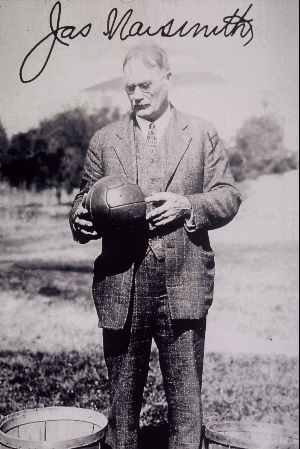
Dr. James Naismith, Inventor of Basketball
KU Basketball Program Founder

Dr. James Naismith is known world-wide as the inventor of basketball. He was born in 1861 in Ramsay township, near Almonte, Ontario, Canada. The concept of basketball was born from Naismith's school days in the area where he played a simple child's game known as duck-on-a-rock outside his one-room schoolhouse. The game involved attempting to knock a "duck" off the top of a large rock by tossing another rock at it. Naismith went on to attend McGill University in Montreal, Quebec, Canada.

After serving as McGill's Athletic Director, James Naismith moved on to the YMCA Training School in Springfield, Massachusetts, USA in 1891, where the sport of basketball was born. In Springfield, Naismith was faced with the problem of finding a sport that was suitable for play inside during the Massachusetts winter for the students at the School for Christian Workers. Naismith wanted to create a game of skill for the students instead of one that relied solely on strength. He needed a game that could be played indoors in a relatively small space. The first game was played with a soccer ball and two peach baskets used as goals.

James Naismith devised a set of thirteen rules of basketball:

1. The ball may be thrown in any direction with one or both hands.
2. The ball may be batted in any direction with one or both hands, but never with the fist.
3. A player cannot run with the ball. The player must throw it from the spot on which he catches it, allowance to be made for a man running at good speed.
4. The ball must be held in or between the hands. The arms or body must not be used for holding it.
5. No shouldering, holding, pushing, striking or tripping in any way of an opponent. The first infringement of this rule by any person shall count as a foul; the second shall disqualify him until the next goal is made or, if there was evident intent to injure the person, for the whole of the game. No substitution shall be allowed.
6. A foul is striking at the ball with the fist, violations of Rules 3 and 4 and such as described in Rule 5.
7. If either side make three consecutive fouls it shall count as a goal for the opponents (consecutive means without the opponents in the meantime making a foul).
8. Goal shall be made when the ball is thrown or batted from the ground into the basket and stays there, providing those defending the goal do not touch or disturb the goal. If the ball rests on the edge and the opponents move the basket, it shall count as a goal.
9. When the ball goes out of bounds, it shall be thrown into the field and played by the first person touching it. In case of dispute the umpire shall throw it straight into the field. The thrower-in is allowed five seconds. If he holds it longer, it shall go to the opponent. If any side persists in delaying the game, the umpire shall call a foul on them.
10. The umpire shall be judge of the men and shall note the fouls and notify the referee when three consecutive fouls have been made. He shall have the power to disqualify men according to Rule 5.
11. The referee shall be the judge of the ball and decide when it is in play in bounds, to which side it belongs, and shall keep the time. He shall decide when a goal has been made and keep account of the goals with any other duties that are usually performed by a referee.
12. The time shall be two 15-minute halves with five minutes' rest between.
13. The side making the most goals in that time shall be declared the winners.

In addition to the creation of the basketball, James Naismith graduated as a medical doctor, primarily interested in sports physiology and what we would today call sports science and as Presbyterian minister, with a keen interest in philosophy and clean living. Naismith watched his sport, basketball, introduced in many nations by the YMCA movement as early as 1893. Basketball was introduced at the Berlin Olympics in 1936. Today basketball has grown to become one of the world's most popular sports.
Read More......

Soccer History

Early kicking games

All throughout history, many ball games have emerged as well as perished independently to one another, often leaving us with nothing but speculations. Considering that many of these games were impulsive and had few or no regulations, it is likely that they also were quite violent. The roughness of these early games surely must have demanded involvement of the legs, for kicking.We have to emphasize the difference between such scuffles and today's skillful game.

Even although modern football evolved from rugby, a major distinction stands between the two - the feet are not only used for kicking but also for controlling and moving the ball (dribbling). Using body parts other than the feet, like the head or chest, is another factor suggesting the development advanced technical skills.While most ancient ball games had no proven relation to rugby or simply diminished ignominiously long ago, they certainly must have produced skillful players or artisans, much like the superstars of today. Therefore, we must acknowledge these as predecessors of the world's most popular sport.


Middle Ages

The Middle Ages Europe were the stage for violent town games known universally as Mob Football. It is very surprising to notice the progress of ball games in this historical period and consider their violent upturn. In contrast to the ball games of Ancient times, authorities often prohibited and opposed their practice.

The techniques of soccer have been around for centuries. In 2002, Japan hosted
the World Cup for the very first time. Few were aware that the locals have been
playing a juggling game called Kemari for the past 2300 years.
Association Football

During the second part of the 19th century in England, rugby as well as most sports experienced a massive surge in popularity. This was mostly an effect of the Industrial Revolution, which drew people in cities and factories, depriving them from the typical outdoor activities of rural life. Recreation became common and people turned to sport on Sundays, in addition to their religious activities. British traders, sailors and workers spread sport and football all over the globe through their web of colonies

Modern Era

Soccer, as we know it today, was molded during the 1960s. Increased media coverage and TV broadcasts made the game far more popular than it ever was. Commercial air flight replaced traveling by ship, which made it more efficient to conduct international matches.
Jules Rimet (left) was president of the French football
federation and FIFA at the time of the first World Cup. The original World Cup
trophy was named in his honor. The trophy itself had a rocky history: During
World War II, Ottorino Barassi, an official of the Italian football association,
hid it in a shoe-box under his bed. Later, it was stolen during a public
exhibition just before the 1966 World Cup Final, then recovered and stolen
again, seventeen years later in Brazil. It hasn't been found seen since and many
speculate that it may have been melted.

Read More......